
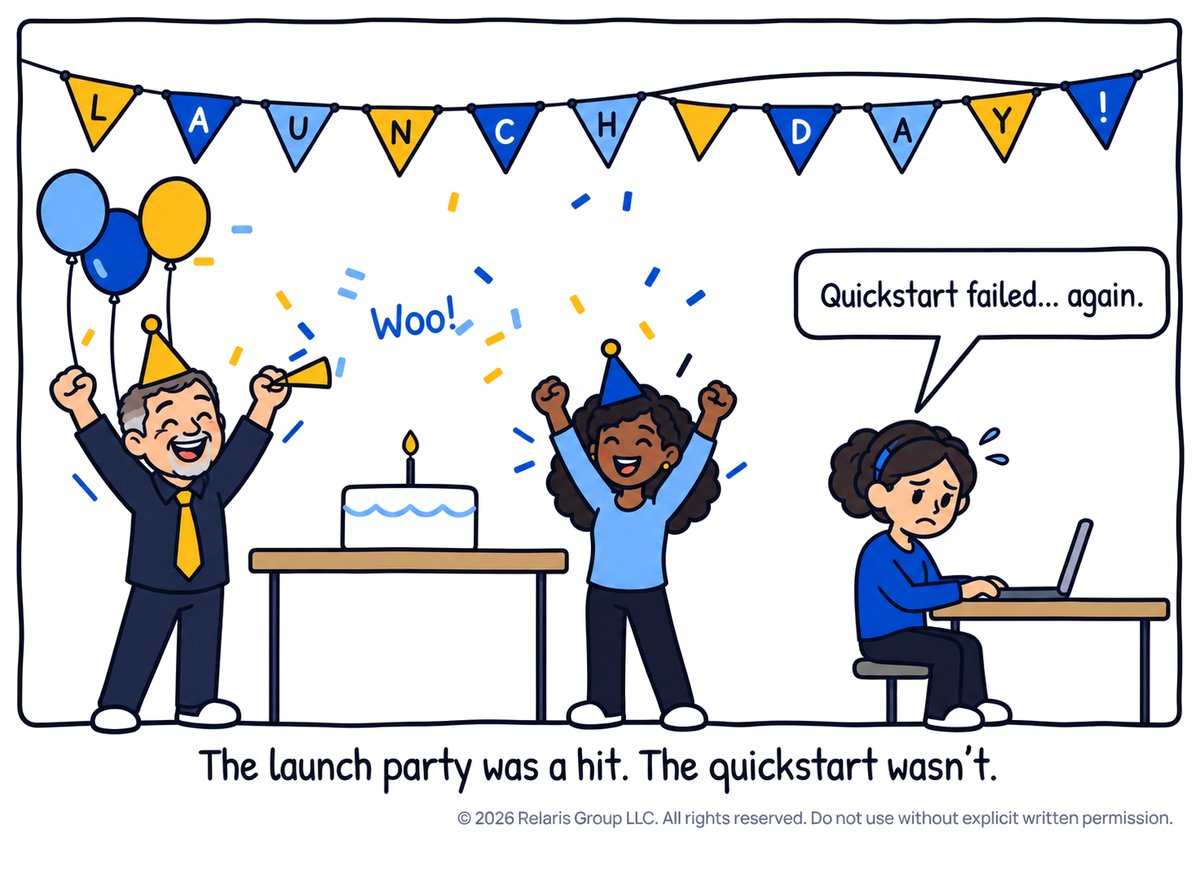
Your last launch reached thousands of developers. The campaign performed well, traffic increased, and metrics improved. Congratulations!
Do you know how many of them made it to a first build? Did they understand the Quickstart guide? Are they moving forward in their journey?
As marketers, we have all celebrated community growth, GitHub stars, and launch registrations as ways to build brand identity and awareness, especially for new products, offerings, or companies with little prior recognition. But these are only initial steps. These metrics don’t show whether developers understand the product, complete a meaningful first build, or keep using it.
Early in my career, reported metrics focused on reach, clicks, and impressions. At launch, those numbers looked like success. They reinforced brand identity and created hype around the new offering.
Then the momentum disappeared. We had focused on reach numbers instead of a frictionless journey. Registration failed, or the messaging didn't resonate, so no one built. We lost them to a competitor, or the friction was so high they gave up. They were not adopting.
Developer adoption is measured by how many developers complete a first successful build and keep using your product.
Why Expanding Reach Alone Doesn’t Drive Developer Adoption
Expanding reach does not guarantee growth if developers struggle to understand your product, register, or complete their first task. Identify where progress stalls and what needs improvement.
Messaging and positioning that isn’t technically focused or targeted to the right users and buyers may attract the wrong use case. Registration may be difficult to find or confusing. Documentation might omit prerequisites, or a quickstart may fail. Each of these raises drop-off rates instead of improving conversion.
Repeated campaigns that don’t change the message or don’t help developers move to the next step in their journey only send them through the same experiences and obstacles. The frustration builds, so they give up and move on. The right developer experience can drive adoption and keep developers coming back again and again.
Amplitude’s 2025 Product Benchmark Report, based on data from over 2,600 companies, found no meaningful correlation between how well companies acquire users and how well they keep them. Attracting more users did not lead to higher retention.
All of this can impact your return on investment. If you keep investing in acquisition while obstacles remain, that investment may yield little value. Before increasing spend, consider whether improving the current journey could help more of your existing audience succeed. To do that, you first need to see where developers drop off in the journey.
Key Metrics and Stages in Developer Adoption
Every developer moves through six stages: Discover, Evaluate, Engage, Learn, Build and Adopt. Reach happens at the Discover stage. Each stage after it has its own drop-off, and that is where your investment either pays off or fades.
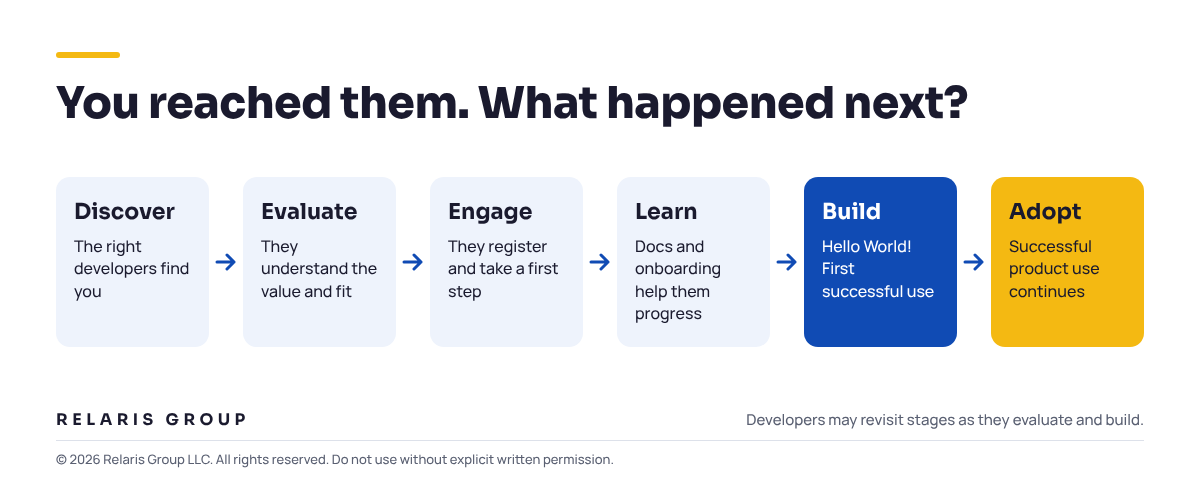
Identify where your investment loses momentum
Understand what developers aim to accomplish and what prevents their progress. Someone who leaves before registration faces different challenges than someone who signs up but never completes a useful task. A successful trial that does not lead to ongoing use presents another issue. Each scenario may require a different response and investment.
Your metrics should distinguish these situations. Registration completion may reveal signup or onboarding challenges. Time to first success highlights onboarding effort. Repeated, meaningful use indicates ongoing value. With AI, an agent may generate thousands of requests, but the key question is whether developers achieve meaningful outcomes and keep doing so.
Common metrics to measure developer adoption include:
- Registration completion rates (identify signup and onboarding challenges)
- Time to first successful build, such as a “Hello World” or first API call (measure onboarding effort)
- Retention rates (track how many developers return over time)
- Active developers: those who repeat a core action, such as a production API call, over 30 days (show how many rely on your product)
A smooth onboarding experience helps developers succeed faster, reduces friction, and increases the likelihood of ongoing engagement. In the 2024 State of DevRel report, 61% of survey respondents said proving impact is a challenge. Building the right reporting dashboard for leadership is essential, yet some companies overlook this step.
A good reporting dashboard shows where developers drop off and why. The cause is usually a common friction point, such as a product issue or missing technical documentation that slows developers down.
Combining reach, engagement, and product activity into a single growth metric may look positive but can obscure how many developers registered, built successfully, and continued using your product. Leadership needs to see these stages separately, with clear definitions, to understand where investment is effective, where the journey stalls, and why.
Organizations need help defining these measures and designing a dashboard that links developer progress to GTM and business goals. This gives leadership, product, engineering, marketing, and DevRel a shared foundation for deciding what to improve and where to invest.
The goal is clear: more successful evaluations from your current audience, less avoidable support work, and more developers progressing to ongoing use. Define the desired outcome, establish a baseline, and measure changes. These results provide a stronger basis for investment than simply increasing impressions.
Where to start
Before your next outreach campaign, pick one stage of the journey and measure it well:
- Define what first success means for your product.
- Measure how many developers reach it, and how long it takes.
- Address the biggest drop-off before executing more campaigns.
If your team needs a clearer view of where developers are encountering friction, we can help. Start with one priority metric you want to improve. Our Priority Workshops help you choose it, and our Developer Adoption Assessment reviews every stage of your developer journey, from discovery to adoption, to ensure a smooth, frictionless developer experience.
Relaris Group is a developer relations (DevRel) and developer marketing agency helping technology companies grow developer adoption.
Member of the DevRel.Agency Collective.