
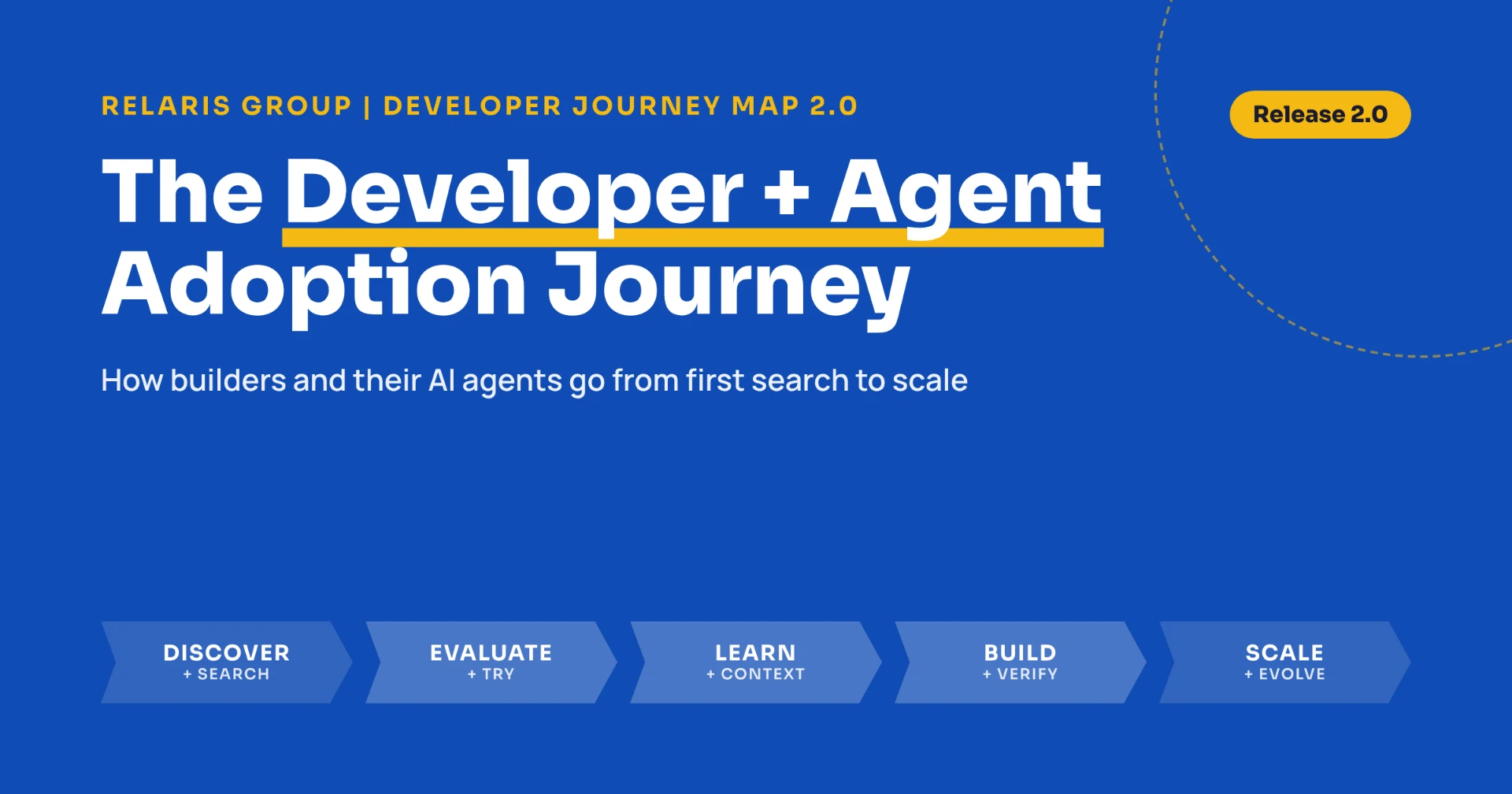
With contributions and thoughts from Jeffrey Kim, DocFrame.io.
Part 1 of 3 in our series on the developer journey in the AI agent era.
We’ve spent years helping companies build developer trust and drive adoption, and for most of that time, the playbook involved reaching the right builders, making their first experience easy, and removing friction until they ship something real.
At the heart of our work was the Developer Journey Map, created by our colleagues Caroline Lewko and James Parton in their popular book Developer Relations: How to Build and Grow a Successful Developer Program (Apress, 2021). The map gave the industry a shared language and framework of five stages developers move through on their journey from discovery to building and scaling with your API, SDK, or other developer-focused product. Notably, it outlined clear touchpoints at every step and marked a Developer Experience zone where many developers could experience friction. That map has been copied, referenced, reimagined, and even posted on cubicle walls.
It continues to serve the industry well, but what happens when the developers you’re trying to reach have stopped coming to you first and rely on AI instead?
The Journey Now Has a Second Traveler
Picture a developer starting a new project. Before visiting your website, they ask their AI coding assistant to recommend tools. If you’re lucky, their coding agent will find your product, read your docs, try your sandbox, and write its first lines of code. The human then reviews the result and decides whether to continue, but they may never see your site. In other words, while the developer journey still involves touchpoints like your website, docs, and issue tickets, more of it now happens inside an AI conversation your team can’t see.
That creates three problems:
- Friction is invisible. When AI can’t find you or read your docs, it quietly moves on without any kind of engagement, such as a ticket, forum post, or dashboard signal.
- Investment goes to the wrong place. Teams keep funding reach and campaigns while potential customers stall at stages no one measures.
- Teams work in silos. Marketing owns the Discover stage, docs owns Learn, and product owns Build, resulting in a disjointed path that the developer and their AI expect to experience as one harmonized journey.
In the Stack Overflow 2026 Developer Survey, 70% of technologists said they ask AI when they hit a problem. The developer journey still has the same stages, but developers now traverse it with AI by their side. AI is leveling the playing field so almost anyone can create an app through plain language, expanding the very definition of “developer” to include a variety of new AI-assisted and vibe-coding “builders.” DevRel and the Developer Journey Map must evolve with this new paradigm: the Developer Agent Experience (DevAX).
In practice, this means your developer journey and its touchpoints must now be agent-aware (aka agent-ready) while still supporting human-led decisions.
A Map for the Agentic Era
This is why we created Developer Journey Map 2.0: Developer + Agent Adoption Journey. It shows how developers, vibe coders, and their AI agents move from first search to scale, and where they encounter barriers to building.
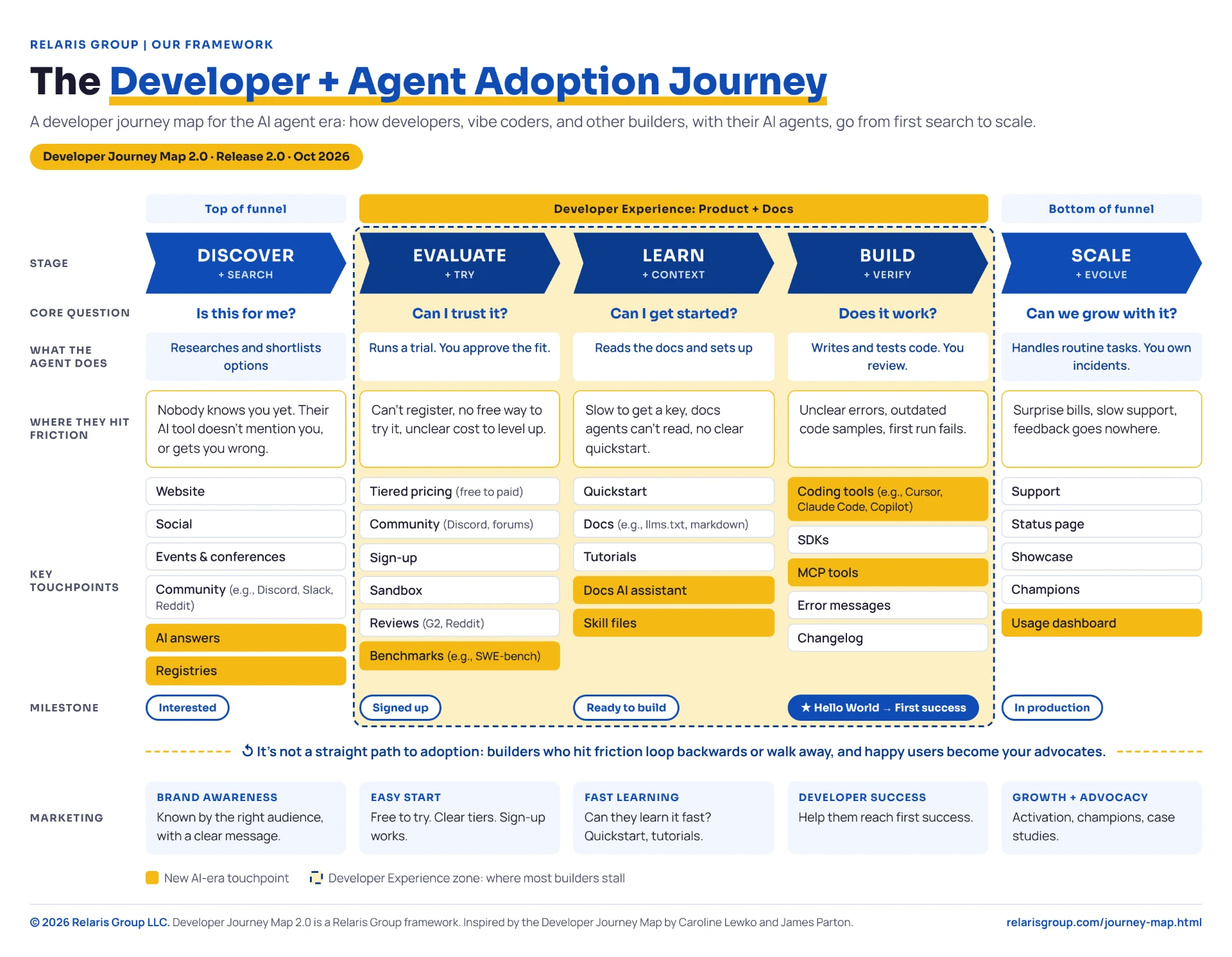
This updated map gives every team a shared view of today’s ideal developer journey, covering what the builder and their AI need, and where both can experience friction. Consider it your starting point for asking the relevant questions about your DevAX, such as:
- Do AI tools name you when a builder asks for a recommendation?
- Can a coding agent get from your quickstart to a working Hello World without human intervention?
- Can someone see what your product costs before talking to sales?
If you’re not answering yes to questions like these, your competitor almost certainly is.
Why We Changed the Map
The original Developer Journey Map set the standard for how our industry thinks about developer adoption. To stay relevant, it must keep pace with the rapid changes in how builders actually work.
In March 2026, 17% of pull requests on GitHub started with an AI agent’s first draft. By September, it was more than 40% (GitHub Octoverse 2026). Builders now hand much of the “how” to AI while deciding the “what.” The original map only tracked the person. It couldn’t see what their AI agent does, or where it breaks down.
That’s the gap DevAX addresses, and why we rebuilt the map around it. Every decision came from asking: what does the builder need, and what does their AI need, at each stage?
Below are a few notes about our thought process behind the new map:
- We kept the five stages because they still hold, and paired each with its AI-era job: Search, Try, Context, Verify, Evolve.
- We added a “What the agent does” row, because teams need to see what AI handles and which decisions still belong to a person.
- We moved friction to Discover because if AI doesn’t name you, builders never reach your site.
- We widened the audience to include vibe coders and other builders working with AI.
- We added a Marketing row because DevRel and marketing often plan separately while builders experience one path.
- We incorporated mention of a loop because builders who hit friction go back or walk away, and happy users become advocates.
A map that keeps evolving
We built this map for the people leading DevRel and developer marketing, and for the teams building products in an agentic world. Neither can rely on a static framework.
We’ll version the map like software, with numbered releases, a public changelog, and updates shaped by what practitioners experience firsthand, so that it keeps pace with the tools builders and their AI rely on, which change every quarter.
Explore the map, tell us what you’d like to see changed through our contact form, and help shape the next release.
What’s Next
As you explore the map, click any stage to see where builders stall, and learn how to check for these issues with your team.
If you’re unsure how your DevAX stacks up in this agentic age, Relaris Group’s services can help! Our Developer Adoption Assessment is led by a developer and a developer marketer who work through your onboarding, docs, messaging, and positioning, including how well your docs serve AI coding agents. Within about two weeks after kickoff, you’ll get a written report that sorts facts from friction. If you know where you’d like to prioritize, our Priority Workshops, including a Developer Journey Mapping session, provide a focused view on how to best leverage the map for your business.
Are today’s developers and builders adopting your product the way you planned? Schedule a free consultation, and we’ll recommend where to begin.
Sources
- Caroline Lewko and James Parton, Developer Relations: How to Build and Grow a Successful Developer Program (Apress, 2021)
- Stack Overflow, 2026 Developer Survey results, October 6, 2026
- GitHub, Octoverse 2026, October 28, 2026
Relaris Group is a full-service developer relations (DevRel), developer marketing, and GTM agency helping technology companies grow developer adoption in the agentic age.
Member of the DevRel.Agency Collective.